Selasa, 20 Januari 2009

Traveling the Ancient Nakasendo Highway - Part 1: Narai-juku


This is the first of a series of articles on what I consider to be one of Japan's world-class destinations, a chain of beautiful historic towns along an ancient highway where time has seemingly stood still since the 1800's. It's one of those rare magical places on earth where you can still read the Shogun's old edicts upon the entrance into town, learn the region's indigenous dance from your eighth-generation Ryokan host after a sumptuous countryside supper, then take an evening stroll along an entire town of wooden Machiya houses with the only illumination coming from the dim row of paper lanterns overhanging the second floor veranda.


This was also our last major destination before our flight home from Nagoya, the beginning of the end of this long train-and-bus trip through West-Central Japan. As we waved goodbye to Matsumoto on a sunny Friday afternoon, a local train took us into the ancient Kiso Valley where we're planning to spend a couple nights among the three best-preserved towns along the feudal-era "highway" of Nakasendo, with a little hiking in between should the weather permit. The names of these towns? Narai-juku, Tsumago-juku, and Magome-juku.


What's with all these "-juku" suffixes? Well, these are the remaining "Shuku-ba", or post-towns, along the old trade route that stretched from Kyoto to present-day Tokyo, and among the last places in Japan where complete functional towns from the Edo-Period have been successfully preserved. Designated 400 years ago by the Shogun's government as official rest stops for travelers, the original settlements and the ancient mountain path that gave birth to them date back at least another thousand years prior. So we're talking about an entire series of towns whose sole purpose of existence was to cater to the flow of ancient traders and travelers, and bustling with traditional inns, teahouses and sundry shops throughout most of their long histories.


Since the railroad effectively replaced the old mountain path a hundred years ago, the towns fell into slow disintegration for decades until the government realized their significance and nationally declared them as Protected Areas of Traditional Architecture. As today's visitors stroll into town with their camera lenses, all they picture is but a fraction of the town's former glory. And nowhere is this more evident than at Narai-juku, our first stop within the Kiso Valley.


Getting to Narai-juku is easy -- just hop off the infrequent local train at the Narai Station of the Chuo Main Line. Once revered as "Narai's Thousand Houses," this small town used to be the major population centre of the region, and today remains the only town served by the JR Train out of the three we visited. The old Nakasendo still serves as the town's main street, albeit paved and parked with the odd Toyota trucks as a reminder that you ARE in the 21st Century.


Even though there's a museum and a few old temples and shrines in town, to us the main attraction here was the town itself and the descendents of the townspeople who had been continually inhabiting these inter-connected rowhouses for centuries. As we were just admiring the wooden facades of each house and soaking up the atmosphere, the local children walked by us with their genuine smiles and "Konnichi-wa!" greetings, then proceeded to scoop up a fresh afterschool drink from one of the many springwater wells along the street. But behind this refreshing friendliness lies the sad observation that these may well be the only elementary school aged children out of a town of several hundred people -- a common phenomenon in this era of urbanization and greying population in Japan. I hate to speculate what would happen to this beautiful valley in thirty years when the older generation passes on.


The main industry in town seems to be the production of traditional lacquerware, as we encountered no less than half a dozen lacquerware studios along the main street, including the lovely Matsuzakaya pictured here. In case you're wondering ... no, this has absolutely no connection with the Matsuzakaya Department Store, and instead has been a local fixture at this remote little town for over a hundred years. Fourth-generation lacquerware artist Uehara-san still handcrafts his nature-inspired motifs into most of the shop's offerings, which ranges from little chopstick stands to large ornamental sculptures. After watching the old master painstakingly polish his latest creations, we ended up buying a teardrop-shaped ladle with red maple leaf motifs (fit for a Canadian, eh?) for measuring tea leaves, for about 600 yen (CAD$6).


Just down the street from Matsuzakaya, the heavy wooden plaque of another lacquerware store (Shibata Shikkiten) hangs beneath a traditional second floor veranda. The smaller plaques on the right state the owner's name of "Shibata Nobuo", as well as the phone number -- "Number 18" -- which gives you an idea of just how small and close-knitted this town is.


The red-white-and-blue of an old barber shop flanks the square gate leading to the village's main Buddhist temple, the Daihoji. The writing on the right pillar states the temple's most famous artefact, which is ironically a quasi-Christian statue known as the "Maria" Jizo. The enigmatic stone statue of a seated female holding a child with an engraved cross is claimed by the townspeople as a Virgin Mary figure disguised as a Buddhist Jizo, referring to an era when when Christianity was banned under the edict of the Shogun.


Unlike the more elaborately feudal towns of Tsumago-juku and Magome-juku, here in Narai-juku time seems to have proceeded in slow motion over the past century, producing an interesting mosaic from different eras of Japan's history. The 160-year-old official reception house from the Shogun'speriod evolved into a Taisho-era (1920's) coffee house that still serves a delicious relic from its time -- rich, smooth "syphon" coffee brewed using vacuum coffee makers. Long considered too time-consuming and mostly eliminated in the Western world, this brewing method is still hailed as the ultimate way to produce top quality, silky smooth coffee in different corners of Japan. If you have time to sit down for a romantic afternoon date, a coffee-and-cake set goes for 750 yen (CAD$7.5) at the time of writing -- not a bad way to pass time while waiting for the next train.


Appearing to pop right out of a 1950's movie set, the unpretentious general store is simply a goldmine of old advertisement signages you wouldn't expect to find outside of museums and movie studios. I just LOVE that old signage of "Matsushita Electrical Appliances," better known nowadays as Panasonic both within Japan and abroad. The other signages advertises two competing brands of a local herbal pill known as Hyakuso-gan, an age-old remedy for gastro-intestinal problems. And then there are the old coin-operated toy dispensers at the store front, weathered and rusted for who knows how many decades. For anyone over 30 who spent at least part of the childhood anywhere in East Asia, this is an absolutlely magical scene reminescent of childhood, of the walk home from school, and of the warmth of elderly storekeepers selling everyone's favorite snacks.


Contributing further to the small-town charm, an oversized ball of cedar twigs announces the presence of the local Sake brewery, in a fashion similar to Austrian Heurigers placing pine twigs to announce the availability of their new wine. The pride of Narai-juku, the Sugi-no-mori brewery has been handcrafting its namesake wine since Year 1793, and is currently operating under 8th Generation brewmaster Hirano Kyuhei. I did check the price out of sheer curiosity: 2500 yen (CAD$25) for a litre of Junmai (pure, non-diluted) Sake, and 7500 yen (CAD$75) for the top-of-the-line Daiginjo ... definitely not on the cheap side as far as Jizake (local brew) goes.


As you might have expected from a town of this size, there didn't seem to be many choices as far as lunch options went. The intriguing Echigoya, with its large signs advertizing mortar-ground, handmade Soba noodles and Gohei-mochi rice cakes, seemed like a decent spot for an informal meal. Prices were relatively cheap -- 1000 yen for a Mountain Vegetable Teishoku set to 2000 yen for a full meal with carp sashimi and grilled Iwana trout -- but we decided to save our room for dinner.


One of the unmistakable signs of springtime in rural Japan is the chirping of nesting swallows underneath old roofs, and in this case, right on top of the name plate of a certain Hara-san.


The shine of a new fire truck was vaguely visible through the wooden lattice of this traditional-looking enclosure, which upon closer examination turned out to be part of the local fire department. With the historic town made up of two connected chains of highly flammable wooden townhouses, it's no surprise that fire prevention is placed at the highest of priorities.


Suddenly a farmer's market appeared out of nowhere and became immediately surrounded by customers who seemed to be waiting for its arrival. Want to bring home an organic Japanese Kabocha squash for dinner? That would be 400 yen. Daikon radishes had been sold out at 200 yen each, while lettuces were still available at two for 100 yen.


And the street goes on and on, with even more lacquerware studios and Minshuku guesthouses and little sidestreets leading to various temples and shrines along the way, until the edge of the town where the main street turns into a cobblestone-and-dirt path -- the REAL Nakasendo -- which winds its way into the wilderness towards the next post-town. So you get the idea ... if hiking is your passion, you could follow the Nakasendo and go on for days, eventually reaching our next destinations of Tsumago-juku and Magome-juku. For ourselves, the speed and comfort of the modern train was good enough.


TRANSPORTATION

Narai-juku is located a little over two hours east of Nagoya on JR's Chuo Main Line, or about 45 minutes west of Matsumoto from the opposite direction. If you're coming from Tokyo, an Express train will get you to Matsumoto in 2.5 hours, where you can then transfer to Narai on a local train. Or if you're from Osaka or Kyoto, simply take the Shinkansen to Nagoya and transfer from there. So it's relatively convenient -- but there are a few caveats to be aware of:


(1) Narai Station is served by local trains only, so visitors coming in from Nagoya on Express trains will need to get off at the larger station of Kiso-Fukushima and wait for the next local train in the direction of Shiojiri/Matsumoto. Visitors coming from Matsumoto should simply take the local train in the Nagoya direction ... otherwise you'll zoom right past Narai. Check the latest timetable at Hyperdia before your trip.


(2) Beware of the "One Man" train, indicated by the above Katakana writings. Some of the local trains along this route are operated as "One Man" trains, where a single conductor (which could be one man or one woman) stands at the first car of the train to examine your ticket and let you off the train ... but this applies only to the smallest local stations such as Narai which does not have a ticket kiosk of its own. In simple terms, the passenger who wishes to get off at such a station needs to sit in the first car, present his ticket to the conductor upon the train arriving at the station, and the conductor will ensure that the cost of the ticket is enough to cover the train fare, then let the passenger off the train by opening only the door closest to the front of the train. We didn't know how it worked the first time, and we would have missed Narai had a middle-aged lady not directed us to hurry to the front of the train as it pulled into the station. Long story short -- just sit at the first car and stay close to the conductor.


(3) If you're not staying overnight and need a place to stash your backpacks like we did, there's an attendant inside the train station who will keep your luggage for about 300 yen a piece ... but you ABSOLUTELY need to get them back before 17:00.


MY WIFE'S CORNER


The old Narai-juku gained its prosperity as the gateway to the mountain pass of Torii-toge, where the Nakasendo Highway crosses Japan's continental divide to reach the other side of the Southern Japan Alps. Well known for the heavy snow dumps in the winter, these mountain ranges are equally famous for the summertime production of high quality fruits such as the famous Kyoho Grapes. The words on this pendant simply spells "Arupusu," the Japanization of "Alps" and a reference to the large, syrupy sweet grapes grown right here in the Nagano Prefecture. This was purchased somewhere between Matsumoto and Narai-juku for about 450 yen.

Kamis, 08 Januari 2009

Curious about Horse Meat in Matsumoto


I must confess that I always, ALWAYS fall for exotic local cuisines wherever I go. It's not that I don't appreciate the cuteness of rabbits or that I don't get grossed out by grasshoppers ... but if it ends up on the dinner plate of the locals, then give me my portion too onegai-shimasu! So when I heard about the local specialty of BASASHI while planning our visit to Matsumoto ... well you know the rest of the story ...

What's BASASHI? I'm not going to dance around trying to euphemize these two simple words ... BA as in horse, and SASHI as in sashimi. Enough said. Your imagination is exactly correct ... we're talking thin, bloody slices of raw horse meat. So if beef sashimi is beyond your acceptance, you should stop reading roughly halfway down this article.


But don't let the culinary history of the locals deter you from visiting one of Japan's most beautiful original castles. Matsumoto may present an impression a modern industrial city upon your arrival at the train station, but take a slow walk along the city's narrow side streets and you'll soon encounter vestiges of its glorious feudal past as a fortified stronghold.

Strategically situated along an ancient mountain route between the Shogun's government in Edo (modern-day Tokyo) and the Emperor in Kyoto, Matsumoto has always been an important castle town in Central Japan and still boasts one of the most recognizable national symbols, the one big tourist attraction any high school student in Japan could name ...


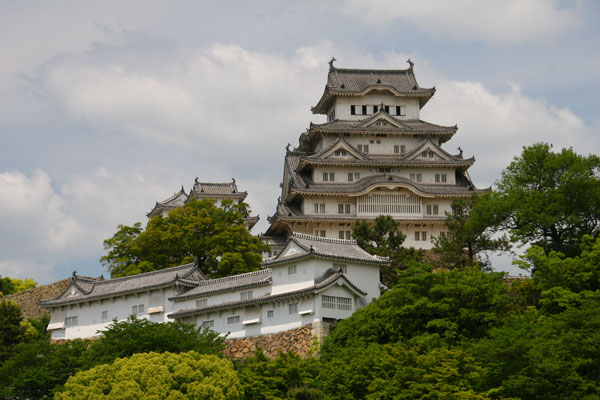
The imposing, black-lacquered Matsumoto Castle dating from the 16th Century, best known as one of the "Four National Treasure Castles" of Japan and on par with the more internationally famous Himeji. And to keep itself on par with Himeji, the city is actually putting together an application for the castle to be recognized as a UNESCO World Heritage Site. But to the Japanese themselves, Matsumoto Castle is already widely recognized as THE perfect opposite of Himeji Castle, with its dark masculine defensive structures forming a stark contrast against Himeji's white plaster walls -- hence the nickname for Matsumoto's "Crow Castle" versus the "White Egret" of Himeji. For a quick visual comparison, here's a picture of Himeji from our previous visit:


As one can see, Himeji is more artistically ostentatious with its sprinkling of roof-top ornaments along the curving rooflines, and its perfectly white plastered walls decorated with large slatted windows. Matsumoto on the other hand is all about strong, masculine straight lines, rectangular crenellations, and a sloping stone base protected by a 20-metres-wide moat. Both are undisputable masterpieces of Japanese architecture, but if I have to pick just one favorite castle ... for me it would be Matsumoto.


Either Matsumoto or Himeji would make a great half-day trip if you're in the neighborhood of Kansai or Central Japan. Unlike the modern concrete-constructed museums like the Osaka Castle or the Nagoya Castle, here you get to walk on the same creaky wooden planks that had been smoothened by the feet of the warlords and his troops for centuries, climb the steep wooden staircases all the way to the top, and stick your head into the defensive crenellations and archer holes.


One of the many staircases leading to the top floors. It's not surprising that many visitors choose to descend the stairs facing inwards, as the act of carrying one's own shoes in a bag with one hand and tip-toeing down the steep stairs in nothing but slipper socks proves a little too intimidating. We managed quite okay as we've gotten quite used to carrying our own shoes at this point of our long journey.


The large collection of historical armours and weapons nicely focussed on one general theme -- the widespread use of firearms at the period of the Castle's construction in the late 16th Century and its effect on Japanese military technology of the time. There were castle construction plans and models, miniature cannons and arquebuses, and helmets and breastplates designed specifically to withstand arquebus shots, as pictured above. These designs must have seen limited use though, as the war ended soon after in Year 1600.


If you get easily bored by exhibits and explanation like me, there's always nice views of the castle grounds just outside the windows. Samurai residences and administrative manor houses were burned down through the course of history and no longer remains, and is now replaced by the lush greenery of the castle park. In case you're wondering where we were able to find this large window among the castle's little crenellation openings, this picture was taken from the Tsukimi-yagura (moon-viewing tower), a newer wing built during peacetime.


Of course the best view is always afforded at the very top of the Tenshu tower, which stands at 6 storeys and 29 metres high above the surrounding park. This is the westerly view on a sunny but slightly foggy day, with the quasi-westernized tower of the Old Kaichi school visible in the background. Unfortunately this is probably the best viewing direction IMHO, as the other three directions all have big ugly rectangular buildings in the foreground blocking the view, reminding the visitor that this is a 21st Century industrial city after all.


There are a few other attractions besides the castle. The Old Kaichi school, Japan's first westernized elementary school dating from 1873, is located just a block west of the castle. The world's largest Wasabi plantation is located near the town of Hotaka roughly 30 minutes to the north by train, if you're interested in a unique farm visit with Wasabi-flavored beer and ice-cream. But aside from these plus a handful of little specialty museums (eg.the Ukiyo-e Museum), the city really starts to drop off in terms of tourism resources. My own evaluation is that Matsumoto is a small and pleasant city to spend a day, but it's really no match for Hida Takayama or Kanazawa if you have time for only one city in Central Japan. And this is precisely why we didn't even stay overnight here -- IMHO there are more interesting places to stay in Central Japan, as I'll explain in the next few articles.


WHAT ABOUT THE HORSE SASHIMI?

OK. I've kept some of you waiting long enough. If horse meat is a taboo in your culture or if you have no interest in reading about Horse Sashimi, you can stop now. Otherwise ... I know I'll get flamed for this ...


Food Review: MIKAWAYA (Matsumoto)
Address: Nagano-ken Matsumoto-shi Chuo 3-8-14
Hours: 11:30-14:00, 17:00-21:00; Closed on Sundays
Website/Map: From Gurume Pia (Japanese)
Directions: Exiting JR Matsumoto station and walk East along Route 143 for about 8 blocks. At this point Route 143 will follow a smaller street (Ohashi Dori) to the left ... so turn left to keep following it. Finally, turn right at the next block. Mikawaya is the large antique-looking house on the right hand side of the street, right across from the Ryukoji temple. If you get lost, just politely ask a young guy where Ryukoji is. The whole walk should take about 15 minutes ... or you can take the Town Sneaker shuttle bus' Northern Course and get off at "Ohashi Dori Minami" (see Transportation section below).


If you're just waiting to see me digging into my plate of bloodied Horse Sashimi like a wild man, you may be mildly disappointed. Our review candidate is actually one of the highly cultured culinary establishments of Matsumoto, a historical institution frequented by local dignitaries and men of literature. Today it is still housed within a venerable two-storey-tall Machiya townhouse with authentic dark wood lattice windows on white plastered walls. You'd think it's a museum of some sort except for the subtle greeting written on the old Noren curtain with a few simple words:

Matsumoto Mikawaya, established in the 16th year of Emperor Meiji (Year 1883 in the Western world)


Before going further I have to point out that I live in Canada where the consumption of horses is considered somewhat taboo, due largely to the public perception of horses as companion animals or pets. But I also understand that serving horse meat is quite the norm in some regions of Italy, France, China and Japan ... incidentally all culinarily influential nations with great gourmet traditions. And on this trip to Central Japan, I felt that I owed myself an excursion to a culinary institution that specializes in this regional delicacy which I have no chance of trying out at home. That, is precisely why I chose to come to Mikawaya.

Prior to arriving in Japan I did my homework on Japanese foodie websites such as Tabelog, just to see other peoples' opinion on what to order and what to avoid at Mikawaya. Apparently the two most popular dishes here were the Sakura-nabe (literally "cherry blossom hotpot"), which appeared to be very similar to Sukiyaki but with horse meat replacing beef, and the Basashi, which was thinly-sliced raw horse meat served with a grated ginger soy sauce. As we arrived on a slow Friday afternoon, the only other client, a conservatively dressed Ojisan in his fifties, was having precisely the Sakura-nabe. In fact each table had a natural gas stove set-up just for Sakura-nabe, as you can see in the picture above. Surrounding us with its square wooden beams and latticed windows, Mikawaya was exactly how I imagined it to be -- antique, dimly illuminated, and tastefully Japanese.


Even the menu took the form of a handwritten ledger book from a century back, with each offering and its price written simply in calligraphy brush strokes of black ink. A set meal of Basashi Teishoku cost 1995 yen (CAD$20), a side order of Basashi cost 1575 yen (CAD$16), while a side order of horse meat skewers cost 1470 yen (CAD$15) ... and if you can't read Japanese? I guess you'll just have to take their word for it.

But the bad news came on the flip side of the menu -- the Sakura-nabe was available for 2940 yen (CAD$30) per person, but the minimum order was for two people. Now we had two choices: either both of us would share the Sakura-nabe, or I would order the Basashi Teishoku and leave my wife the freedom to order something else other than horse meat. Not a tough choice, given the fact that she was generally less adventurous than I was towards unfamiliar cuisine. Within 15 minutes I got what I'd been wishing for ... and then some ...


Whoa!! I never had Basashi before, and I had expected just a few thin slices of raw but only slightly moist horse meat, perhaps even torched on the outside and pre-mixed with a dressing -- kind of like how Beef Carpaccio is served in Izakayas throughout Japan. I certainly didn't expect it to be a large fillet of thickly sliced horse meat, only slightly cold, soft and still dripping with blood. Seriously ... picking up each slice with my chopsticks revealed a small dab of blood on the plate ... it was THAT raw. Now I'm not a squeamish eater -- sea cucumber intestines and coagulated chicken blood are among thing that I actually enjoy eating -- but thick, blood-soaked slices of meat that was starting to approach room temperature if I didn't finish it within the next few minutes? Just by the looks of it, that's blurring the line between enjoyment and bravado.

But of course, I had learned my lessons through travelling that I should never judge a dish by its looks. I started to rub into each slice of Basashi a generous helping of grated ginger, which I knew was provided for neutralizing any strong and unwelcome taste in the meat, and then dipped them into Sashimi soy sauce. As the bloodiness of the meat was still bothering me a little, I initiated the first slice into my mouth with a small ball of rice, as if I was having Sushi ...

And it's actually not bad! Once I got past the psychological barrier, the meat revealed a delicate sweetness accentuated by the Sashimi soy sauce and, needless to emphasize, the juiciness of the fillet cut. The texture was little different from lean beef, except that it was incredibly tender -- much more so than I would expect from a beef cut of similar leaness. Before long I was having my Basashi without the rice, and started to truly enjoy my lunch without further hesitation.

Towards the end I did find the Basashi portion a little too large for me ... I guess the blood and everything else was getting to me after all. Like any decent Teishoku set, the meal did come with all the fixings such as a soup, a cold appetizer dish, and of course steamed rice and pickles. The 1995 yen (CAD$20) was quite worthwhile for a full and interesting meal that I'll surely remember for years.


And for my wife? The tasting of one slice was quite enough Basashi for her, as she went back to work on her Pork Misoyaki. Unfortunately the quality of the pork was no different from what can be expected at any little family-run eatery, and certainly not worthy of the Mikawaya name. Perhaps we should have had the Sakura-nabe for two, which should be interesting but also twice as expensive.


It was probably not the best time to ponder this sensitive question, especially right after such a full and gracious meal ... but where DOES Mikawaya's horse meat come from? The restaurant's own literature claims that it only sources a domestic Japanese breed known as Dosanko, all supplied by licensed farms in Hokkaido. I don't know if this is supposed to make me feel better, as I've previously heard many stories of how race horse stables often file a "change of usage" for their sub-standard and retired race horses and sell them into the food chain. There are even rumours about the 1987 Kentucky Derby champ ending up in a Japanese stable upon retirement and ... well you can imagine his ending. Not that I don't trust Mikawaya's declaration though -- a 120-year-old restaurant of such high acclaim is probably the safest place to find truly uncontaminated, farmed horse meat -- but this is just something that unsuspecting culinary tourists may want to keep an eye on.

The final verdict? For me it was more of a cultural adventure than a food tasting really. The sweet tenderness of the Basashi was certainly interesting to try, but frankly the cold, dripping bloodiness started to lose its appeal after five or six slices. A half order of it would serve very well as an appetizer though, and following it with a Sakura-nabe for two would be a perfect introduction to horse meat.

Bill for Two Persons
Basashi Teishoku1995 yen
Pork Misoyaki Teishoku840 yen
TOTAL2835 yen (CAD$28)


TRANSPORTATION

As one of the major JR stations in Central Japan, Matsumoto is served by Express Trains directly from Tokyo and Nagoya. Tokyo's Shinjuku Station is only 2.5 hours and 6700 yen (CAD$67) away, while the Express Train to Nagoya takes only 2 hours and cost 6000 yen. From Osaka or Kyoto it's probably easiest to just transfer through Nagoya.

If you're starting out from Tokyo, a much cheaper and almost-as-fast alternative is to take the JR Highway Bus outside the Shinjuku Station, costing half the price of the train (3400 yen) and getting you there in 3 hours.

But my own suggestion would be to combine your visit to Matsumoto with a trip to Takayama -- and a side trip to Kamikochi and see the National Park if you have the time. All this can be done by taking the Nohi Bus, which operates a Matsumoto-Takayama bus route with multiple daily departures taking 2.5 hours each way. The connection to Kamikochi is roughly halfway between the two cities, where you can get off at the hotspring resort of Hirayu Onsen (see article on Kamikochi for more information) and transfer to a short bus ride to Kamikochi. And the best part is ... Nohi Bus has a wonderful deal -- a 3-DAY, 6400 YEN BUS PASS with unlimited hop-on hop-off between Matsumoto, Takayama, Kamikochi, Shirahone Onsen, and the five Oku-Hida Onsengo towns from Hirayu Onsen to Shin-Hotaka.

You can see the Bus Timetables and details about the 3-Day "Norikura-Kamikochi Open Ticket" at Nohi Bus' English Website. Just one word of caution if you plan to use the bus pass -- it is sold only at Takayama's Nohi Bus terminal, which means that you'll have to get to Takayama first and then travel to Matsumoto and Kamikochi using the pass. It's still quite a deal nonetheless, if it fits into your travel plans. Otherwise you'll need to buy your bus tickets one by one.


Once you get here, central Matsumoto is really small enough to explore on foot, as the Castle is only about 20 minutes walk from the JR Station. But if you're lazy like us, an alternative is to take the above mini shuttle bus known as the Town Sneaker. There are a total of three routes, and we found the "Northern Course" to be the most useful, as it covers the Castle (get off at "Matsumoto Castle Kuromon"), the Old Kaichi School (bus stop "Takajomachi"), and the Mikawaya restaurant (bus stop "Ohashi Dori Minami"). It's 190 yen (CAD$2) per ride and 500 yen (CAD$5) for a Day Pass, which is not a bad deal since you get 60 yen off the Castle Admission simply by flashing your Town Sneaker Day Pass. Check the Town Sneaker's English site for the latest timetable.


MY WIFE'S CORNER


The world's largest scale cultivation of Wasabi -- the Daio Wasabi Farm -- is located just 30 minutes north of Matsumoto. This is a matter of great pride to the citizens of this region, as the Wasabi plant is notorious for requiring the cleanest of water sources for growth. Even though Wasabi may be best known for its use in Sushi, virtually none of the Sushi-ya we've ever visited in Japan served freshly-grated Wasabi ... I guess even the Japanese are getting used to the powdered stuff nowadays. This cellphone pendant is called ... guess what ... the Wasabi Version, and is marked for sale only within the Nagano Prefecture. So technically you may find this in Matsumoto, Nagano, Suwa, and even as far south as Tsumago.

Kamis, 25 Desember 2008

Hotspring Hopping in Oku-Hida Onsengo


My skin must have wrinkled like a relief map of the surrounding mountains of Central Japan, as I took 4 baths in 9 different hotspring pools -- all in the course of a 16-hour period.

Even though I've had some hotspring experience in Canada, Hungary and Eastern Japan prior to this trip, to visit a mountain-side hotspring in its natural state in the hotspring-crazed nation of Japan was a highlight I looked forward to for months leading to the day. This was in a remote mountain valley in Central Japan, situated at a turn-off on Route 158 halfway between the cities of Takayama and Matsumoto, not far from the road into Kamikochi. This valley consists of a loose collection of five little hotspring towns -- Hirayu, Shin-Hirayu, Fukuchi, Tochio, and Shin-Hotaka -- known together as Oku-Hida Onsengo.


We picked Hirayu Onsen out of the five towns for our overnight stay, mainly due to its location as the main transportation hub in the region. This allowed us to arrive from Takayama in the morning, take a 30-minute bus ride to see the National Park at Kamikochi, return in the late afternoon for some bathing, then depart for Matsumoto the next morning.

Upon arrival at Hirayu Onsen, one of the most recognizable landmarks was the tall lantern-stand outside the entrance of our Ryokan (more about it below), and the narrow hotspring pool at its stone base providing a free-of-charge foot bath for weary travelers waiting for the next bus connection. There's another bigger foot bath at the centre of the village if you're a foot bath fan, but this one is located next to the bus terminal and allows you to see the buses coming in while you enjoy the water.


Hirayu Onsen is an Onsen (hotspring) town after all, and sightseeing attractions is just not its forte. There is one little museum in town known as the Hirayu Minzoku-kan which exhibits three thatched-roof farmhouses, but the main draw for the 500-yen entrance fee is the bathing in the open-air hotspring pool within the museum grounds.

The other attraction in town is the large park surrounding the Hirayu Ootaki, famous for its illuminated display of a frozen waterfall during the winter. We felt that it didn't justify our time as we arrived in May ... we've seen enough waterfalls living in Canada.


The town itself was small and nondescript, and could be mistaken for any of the hundreds of similar hotspring towns across Japan. But as all hotspring-goers know, it's the quality and ambience of the hotspring pools that really matters. So I thought I'd start by seeking out the town's most famous hotspring pool ...


... the Kami-no-Yu, the small, rustic great-granddaddy of all hotsprings in the region. Legend has it that an invading 16th Century warlord discovered this copious source of spring water, which has stayed true to its origin as just a couple of natural rock-lined pools in the middle of the wilderness. This is pretty remarkable considering the Japanese tendency to over-develop any hotspring resort -- just look at the "original" hotspring pool in Gero just a couple hours drive to the southwest ... the source once-revered as one of the "Three Famous Hotsprings" is now just a concrete pool right underneath a highway overpass surrounded by a myriad of ugly hotels. Talk about killing the goose that laid the golden egg!

As you can see I was pretty stoked about my first dip in a Japanese natural hotspring ... one that is outside a Ryokan or a public bathhouse. The path to Kami-no-Yu was well marked with signs like this one ... no English on the signage of course, nor do they expect any foreigners. Even though the town brochure said 10 minutes walking distance, it probably took me closer to 20 minutes as it turned out to be a long, winding uphill climb, which seemed even longer as the occasionally bather zoomed by in a car.


Already out of breath and in desperate need for a hot bath to recuperate my thighs, I finally made it to the entrance at about 17:00. As you can see the closing time seemed to vary with little warning, and I suspect they would just close sooner on slower days and run until 19:00 on holidays and weekends. The other finer prints are just the generic bathing rules such as "No bottles and cans in the open-air bath." A few metres after this sign stood the concession stand, where a middle aged lady collected my 500 yen (CAD$5) entrance fee and also sold various refreshments and fruits. Well, it's not TOO basic after all -- I would have loved a free bath.


As it turned out there were a total of four pools -- one open-air bath for males, one for females, one private indoor bath for families, and one other private bath in the form of a giant metal pot. So ... no Konyoku (mixed-sex bathing) ... unless you bring your whole family and have a big bath together like some Japanese families do. Once you choose the pool you want, it's just a matter of stashing your clothes inside one of the baskets in the little wooden shed (no lockers ... so don't bring anything valuable), then bring your own Tenugui (small wiping cloth) with you and head off to the bath.


And bring your own soap and shampoo too if you don't want to use the generic body soap offered by the facility, as Japanese bathing etiquette requires cleaning and rinsing oneself thoroughly before venturing into the pool. As I stood naked and washed myself at the pool side, the faint odor of sulphur emanated in the air, almost in an inviting way as I prepared to test the water temperature with my feet.

The edge of the pool was warmer than luke-warm, but not as hot as I would prefer. It started at only around 37 degrees Celcius by my estimation, but got increasingly higher close to the spring source, which was directed into the pool from above using a bamboo pole. The colour of the water was just slightly yellow, and bits of whitish minerals could be seen suspended in the cloudy water. Just two middle-aged Japanese men shared the bath with me on this weekday afternoon in May. Neither stayed for very long, which was great since I could then bring out my cheap point-and-shoot camera for a few pics of my own.


Now THIS was the hotspring experience I had come for -- a shoulder massage from the steaming hot water source, hidden in the seclusion of nature and uninterrupted by any other bather. This moment alone was worth spending the night at this little hotspring town in the middle of nowhere. And the spring source was HOT!!! Very hot in fact, even higher than the maximum 42 degrees Celcius offered at most hotspring resorts. I couldn't last very long under this temperature and had to get out of the pool, cool myself down, then get my other shoulder massaged and so on for a few times.

After 40 minutes or so all my aches were gone, and of course the road back to town was all downhill from here, so to speak. Funny I never noticed the beauty of the lush green forest and the serene mountain stream during the grinding uphill walk ...


Hotel Review: HIRAYU-NO-MORI (Hirayu Onsen)
Address: Gifu-ken Takayama-shi Oku-Hida Onsengo Hirayu 763-1
Price: 9000 yen per person including dinner and breakfast (1000 yen less for rooms without private bathrooms)
Website/Map: http://www.hirayunomori.co.jp
How To Book: Through the official website
Directions: One minute walk from the Hirayu Onsen bus terminal, towards the uphill side on the right side of the road.


Baths, baths and even more open-air baths ... this is the main reason people come to Oku-Hida Onsengo. I have to borrow a picture from the Ryokan's official site since I took the bath at night and didn't bring my camera. Please contact me if you're the owner of this photograph and would like me to take this photo down. Otherwise, this is an excellent illustration of the hotspring experience you can expect at any one of the many Ryokans along this valley.

Being one of the largest Ryokans in the region, Hirayu-no-Mori boasts a total of 16 fully open-air hotspring pools, with 7 on the male side and 9 on the female side. I walked in at the uncharacteristic hour of 21:00, when almost all of the guests have retired to their rooms and I had sole possession of all 7 hotspring pools on the male side. It was a clear early summer night, with the sky so clear that I could pick out the big dipper and the milky way while floating in the hotspring pools. And yes, I did try all 7 of the pools, and ended up spending most of my time in the two hottest ones.


Again there was no mixed-sex bathing in the public section, but for couples and families, the Ryokan provided a few private baths for its guests on a first-come-first-serve basis. These were giant semi-outdoor bathtubs in the form of semi-spherical metal pots, divided into an indoor half and an outdoor half by a wooden sliding divider. With a roof over the head and just metres from the Ryokan property's wooden fence, there really wasn't much of a view to speak of. But somehow we found it so relaxing that we came back for one more dip the next morning before checking out.


You don't even need to stay overnight in Hirayu-no-Mori to enjoy the bathing facilities, as the Ryokan offers a "Day Bathing" ticket for a measly 500 yen (CAD$5), which is the same price as the natural Kami-no-Yu but with a whole selection of nicer, albeit artificial pools. This could be a great plan if you're only passing through this area for the day, and are in need for a hotspring fix and a lunch spot. There is one public restaurant in the Ryokan, serving typical Central Japanese dishes such as Hida Beef and wild mountain vegetables.


You can see the sign of a successful hotspring Ryokan by the plethora of souvenir items in its gift shop. Most of these would make nice gifts to bring home to friends and family, but for us there is only one essential item to bring home ...


... Oku-Hida Onsengo's own Yu-no-Hana, the mineral salts collected from the evaporation of the hotspring water and the true essence of any Onsen. Two spoonfuls into my bathtub and I can enjoy the same cloudy, skin-smoothening hotspring water at the comfort of my home. This is by far the best natural bath salt I've ever used, and it's only 315 yen (CAD$3) for each 250 gram pouch.

So the bathing facilities were quite excellent, now what about the room and the meals?


There are at least three types of rooms to choose from. Our Tatami-mat room with ensuite bathroom cost 9000 yen (CAD$90) per person including dinner and breakfast, and a Western (2 single beds) room with ensuite bathroom also went for the same price. If you can do without your own private bathroom, you can get a Tatami-mat room for only 8000 yen (CAD$80) per person. Now this is the weekday rate, as the price goes up a little on Saturdays, holidays and the summer peak season. If you're a fan of hotsprings, or if you just want an authentic Japanese hotspring resort experience, 8000 yen per person including dinner and breakfast is fairly hard to beat as far as full-service Ryokans go.


On to the dinner, which was quite ordinary and simple by Ryokan standards, but still consisted of nine courses.


Once again we're served the signature dish of any rustic Central Japanese dinner -- a roasted Iwana trout dusted with sea salt. The pairing of the saltiness of the Iwana Shioyaki with a sweet chestnut was interesting though. First of all that's quite a contrast of flavors and textures, and secondly ... I thought chestnuts are usually served in the Autumn season as far as Japanese cuisine goes!


To me the interesting thing about this dish wasn't the tempura itself, but the Chef's display of confidence in his own ability evident through his decision of presenting Matcha salt instead of the ubiquitous Ten-tsuyu sauce for dipping. This showed that the Chef wanted his clients to focus on the delicate flavors of his choice ingredients, consisting of Maitake mushrooms, Kabocha squash, and a bamboo shoot. This was probably the best dish of the meal, though IMHO it's still a notch or two lower than what I would expect from a Tempura specialist restaurant ... the amount of residual oil was too heavy for this dish to be considered a complete success.


At the end we came to the dinner's most expensive ingredient -- four thick slices of the region's famous Hida Beef. Well, let's take off the decorative wrapping and examine the beef marbling ...


Well, there was a fair amount of marbling content, but the distribution wasn't entirely even -- you could see a large white area of fatty connective tissue in each of the four slices, and certain areas without any marbling. As expected this wasn't quite as tender as some of the other Hida Beef dishes we've had on this trip -- in fact this was probably the lowest in quality ... an A3 by my estimation. If you want to see a visual comparison against top A5 quality Hida Beef, take a look at the Hida Beef in Hoba Miso at Shirakawago's Shiraogi restaurant.


The next morning we started our routine with another hotspring dip in the private Kama-furo bath, then went to the restaurant for breakfast at 07:00. Once again the breakfast was simple by Ryokan standards, but of course the rice was all-you-can-eat, and we did find our meal quite enjoyable due to two of our favorite breakfast items ...


It was my wife's favorite again -- the Onsen Tamago (hotspring egg) served in Dashi broth. Even though we've been having this dish practically once every couple mornings, we just couldn't get enough of this incredible smoothness of the soft-boiled yolk surrounded by the even softer egg white. I should try to make this at home sometime ... once I get a decent water thermometer to help me keep the water at exactly 70 degrees Celcius for half an hour.


Then it was time for my favorite -- the quintessential Central Japanese dish of Hoba Miso, prepared simply by placing the local red miso and vegetables on top of a dried magnolia leaf and grilling on an open flame. The portion here wasn't quite generous enough for my liking, but it was still memorable as this turned out to the my last encounter with Hoba Miso on this trip. I still wish I had bought a stack of Hoba leaves back in Hida Takayama ... I'm missing this dish so much as I ponder what to cook for breakfast on lazy weekends.

Now we've seen it all ... the hotspring, the room and the meals ... but was it worth the 9000 yen (CAD$90) per person? Frankly the main selling point here is the wide selection of open-air hotspring baths, and it almost seemed that everything else was deemed secondary by the Ryokan management. The room was comfortable but really nothing to write home about, and the meals were quite ordinary really, in terms of both quality and quantity ... or perhaps we're just spoilt by the Ryori Ryokans (gourmet inns) we visited earlier during this trip. Nevertheless 9000 yen was still a fairly cheap price for a full-service Ryokan with excellent hotspring facilities, and taking into account its excellent location as a base for visiting Kamikochi on a day trip, I really should have no complaints.


TRANSPORTATION


Forget about train service to this treacherous region in the middle of the Japan Alps -- highway buses serve as the main form of public transportation here, operated mostly by the Nohi Bus company. The bus terminal at Hirayu Onsen (shown above) is the major transportation hub of the region and the gateway into the other four hotspring towns, as well as to the National Park resort of Kamikochi.

Multiple daily connections run to Takayama (1 hour to the west) and Matsumoto (1.5 hour to the east), both being popular tourist destinations and well worth your visit (see the two articles on Takayama here and here if interested). Both Takayama and Matsumoto are major stations on the JR Train network, and you should have no problem connecting to Tokyo or Osaka in one or two transfers. See Nohi Bus' English website for the latest bus timetables.


If you're planning to arrive from Tokyo directly without stopping over at Matsumoto or Takayama, Nohi Bus operates a daily service from Shinjuku that will take you to Hirayu Onsen in about 5 hours. But this bus is by reservations only, and you need to either phone up Nohi Bus' reservation centre (and be able to speak Japanese), or book through a bus ticket reservation website such as J-Bus (and be able to read Japanese). For most foreigners it's probably easiest to just hop on the Chuo Line train from Shinjuku to Matsumoto, then transfer to the Nohi Bus.


MY WIFE'S CORNER


The fermentation of soy beans into Miso paste is a tradition dating back at least a couple thousand years, especially in the remote mountain hamlets of Central and Northern Japan where the effective storage of summer crops was essential for surviving through the long and snowy winter. To this date the areas surrounding Suwa and Niigata in Central Japan remain some of the best known Miso-producing regions. And one of the most popular national brands of Miso? Suwa's own Shinshu Ichi Miso with its three-centuries-old corporate history as well as one of Japan's most recognizable brand-mascots -- the colourful Miko-chan. This cellphone pendant presents a funny cross-over with Kitty and Miko-chan bathing in a bowl of Miso soup among the tofu cubes. It was bought for about 450 yen somewhere in Central Japan ... but we don't really remember where.